20260317 meeting
Finalizing work v2.0
The purpose of this experiment was originally to reproduce the results of Weather2K and NASA GES DISC MERRA-2 under the same data range as the previous experiment, but without performing time reshaping. However, when running the experiment on the National Center for High-performance Computing (NCHC), we found that the model exceeded the vRAM limitation of a single GPU (the model was too large). Therefore, in this experiment, all experiments were adjusted by reducing the number of Residual layers and then re-running them in order to produce usable experimental and control groups.
In addition, this experiment refactored all previously used experimental code (the SSSDS4 + AFRK implementation was not modified). At the same time, the experimental range of both datasets was unified to a six-month period. The time-series prediction horizon was set to 10% of the sequence, approximately 18 days, and the unobserved locations accounted for 20% of all locations.
While investigating why the original SSSD code could not run directly on multiple GPUs, we found that several steps explicitly specify the computation device as CUDA, such as
| |
This approach restricts the SSSD code to NVIDIA GPUs only, preventing execution on CPU, MPS, TPU, or other devices. Moreover, hard-coding .device("cuda") forces the program to run only on the first GPU ("cuda:0"), which prevents data communication across multiple GPUs. Since rewriting the entire implementation would be extremely time-consuming, we currently do not plan to refactor it. Instead, as mentioned earlier, we reduce certain model layers in order to run the experiments.
Experiment Overview
The following experiments were conducted. Detailed settings can be found in the next section, Experiment Settings.
| Control Variable | Experiment 1 | Experiment 2 | Experiment 3 | Experiment 4 |
|---|---|---|---|---|
| Iterations | 4,000 | 4,000 | 4,000 | 4,000 |
| Training Strategy | $SSSD^{S4 + AFRK}$ | $SSSD^{S4}$ | $SSSD^{S4 + AFRK}$ | $SSSD^{S4}$ |
| Time Reshaping | false | false | true | true |
| Merged Time Steps $p$ | — | — | 8 / 24 | 8 / 24 |
| Input Channels | 4 / 1 | 4 / 1 | 32 / 24 | 32 / 24 |
| S4 Max Seq. Length | 1,176 / 4,608 | 1,176 / 4,608 | 147 / 192 | 147 / 192 |
| Missing $k$ | 88 / 144 | 88 / 144 | 11 / 6 | 11 / 6 |
Experiment naming based on the above table is as follows:
Experiment 1
- Weather2k-1var-S4+AFRK
- MERRA2-1var-S4+AFRK
Experiment 2
- Weather2k-1var-S4
- MERRA2-1var-S4
Experiment 3
- Weather2k-S4+AFRK
- MERRA2-S4+AFRK
Experiment 4
- Weather2k-S4
- MERRA2-S4
Experiment Settings
The configuration used in this experiment is shown below. Only the input/output channels, time series length (S4 max sequence length), missing values (missing $k$), whether AFRK is enabled (enable spatial training), and directory paths vary depending on the specific experiment.
The following example shows the configuration for Weather2k-S4+AFRK.
model.yaml
| |
training.yaml
| |
inference.yaml
| |
The selected experimental locations are shown below.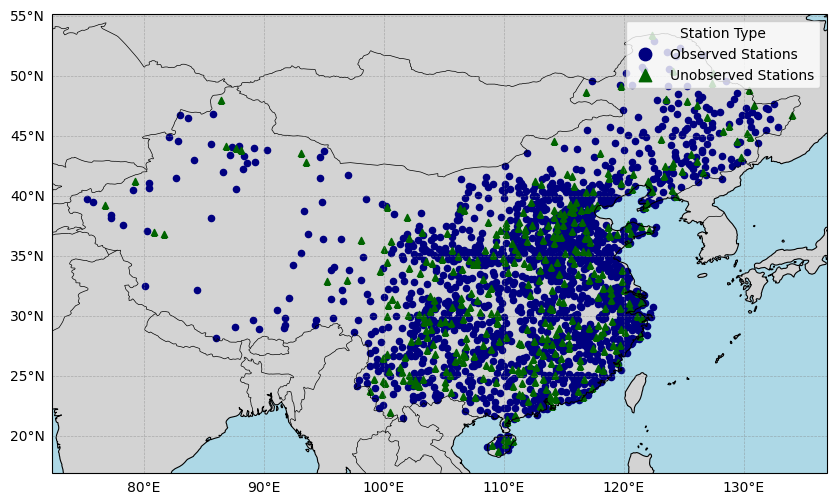
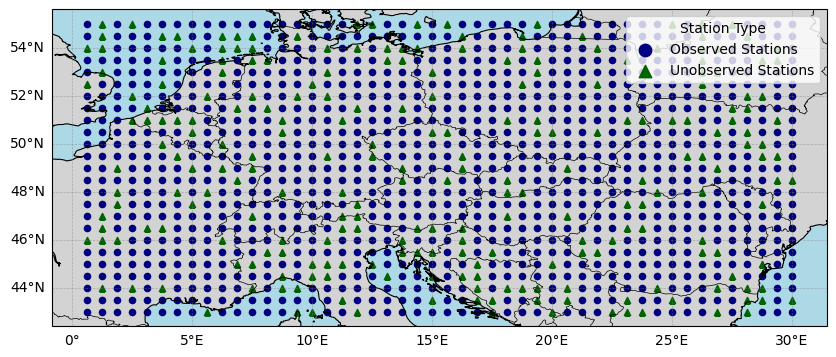
The results of each experiment are presented in the following sections.
Experiment 1
Weather2k-1var-S4+AFRK
Training time: 35h 25m 14.82s (Note: This experiment was not trained on a dedicated machine. It shared the same machine with Weather2k-1var-S4, Weather2k-S4, Weather2k-S4+AFRK during training.)
Number of MRTS bases used by AFRK during the inference stage: 382
| Metric | ALL Locs & All Time | Known Locs & All Time | Unknown Locs & All Time | ALL Locs & Future | Known Locs & Future | Unknown Locs & Future | ALL Locs & Past | Known Locs & Past | Unknown Locs & Past |
|---|---|---|---|---|---|---|---|---|---|
| MSPE | 1.494639e+01 | 1.160173e+01 | 2.828929e+01 | 7.756372e+01 | 7.868970e+01 | 7.307184e+01 | 8.156561e+00 | 4.327126e+00 | 2.343335e+01 |
| RMSPE | 3.866056e+00 | 3.406131e+00 | 5.318767e+00 | 8.807027e+00 | 8.870722e+00 | 8.548207e+00 | 2.855969e+00 | 2.080175e+00 | 4.840800e+00 |
| MSPE% | 1.380822e+10 | 3.299012e+09 | 5.573267e+10 | 2.246783e+10 | 2.608424e+10 | 8.040864e+09 | 1.286923e+10 | 8.283242e+08 | 6.090407e+10 |
| RMSPE% | 1.175084e+05 | 5.743703e+04 | 2.360777e+05 | 1.498927e+05 | 1.615062e+05 | 8.967086e+04 | 1.134426e+05 | 2.878062e+04 | 2.467875e+05 |
| MAPE | 2.332151e+00 | 2.120980e+00 | 3.174576e+00 | 5.441194e+00 | 5.450313e+00 | 5.404813e+00 | 1.995026e+00 | 1.759968e+00 | 2.932743e+00 |
| MAPE% | 7.822800e+08 | 5.627048e+08 | 1.658233e+09 | 5.047446e+08 | 5.480241e+08 | 3.320892e+08 | 8.123742e+08 | 5.642966e+08 | 1.802031e+09 |
MERRA2-1var-S4+AFRK
Training time: 20h 24m 12.59s
Number of MRTS bases used by AFRK during the inference stage: 301
| Metric | ALL Locs & All Time | Known Locs & All Time | Unknown Locs & All Time | ALL Locs & Future | Known Locs & Future | Unknown Locs & Future | ALL Locs & Past | Known Locs & Past | Unknown Locs & Past |
|---|---|---|---|---|---|---|---|---|---|
| MSPE | 160.204191 | 160.390768 | 159.457883 | 1628.647842 | 1631.785612 | 1616.096765 | 0.975361 | 0.841929 | 1.509089 |
| RMSPE | 12.657179 | 12.664548 | 12.627663 | 40.356509 | 40.395366 | 40.200706 | 0.987604 | 0.917567 | 1.228450 |
| MSPE% | 0.611571 | 0.612622 | 0.607367 | 6.222452 | 6.237316 | 6.162993 | 0.003162 | 0.002715 | 0.004950 |
| RMSPE% | 0.782030 | 0.782702 | 0.779338 | 2.494484 | 2.497462 | 2.482538 | 0.056233 | 0.052108 | 0.070357 |
| MAPE | 3.875349 | 3.801459 | 4.170910 | 34.341577 | 34.369929 | 34.228172 | 0.571782 | 0.486805 | 0.911689 |
| MAPE% | 0.014226 | 0.013981 | 0.015206 | 0.128176 | 0.128351 | 0.127477 | 0.001869 | 0.001579 | 0.003032 |
Experiment 2
Weather2k-1var-S4
Training time: 10h 3m 41.84s (Note: This experiment was not trained on a dedicated machine. It shared the same machine with Weather2k-1var-S4+AFRK during training.)
Number of MRTS bases used by AFRK during the inference stage: 382
| Metric | ALL Locs & All Time | Known Locs & All Time | Unknown Locs & All Time | ALL Locs & Future | Known Locs & Future | Unknown Locs & Future | ALL Locs & Past | Known Locs & Past | Unknown Locs & Past |
|---|---|---|---|---|---|---|---|---|---|
| MSPE | 1.160546e+01 | 8.335466e+00 | 2.465048e+01 | 8.308004e+01 | 8.508390e+01 | 7.508604e+01 | 3.855207e+00 | 1.334625e-02 | 1.918156e+01 |
| RMSPE | 3.406679e+00 | 2.887121e+00 | 4.964925e+00 | 9.114825e+00 | 9.224093e+00 | 8.665220e+00 | 1.963468e+00 | 1.155260e-01 | 4.379676e+00 |
| MSPE% | 1.214263e+10 | 2.615445e+09 | 5.014950e+10 | 2.295537e+10 | 2.672051e+10 | 7.935082e+09 | 1.097017e+10 | 1.642926e+06 | 5.472697e+10 |
| RMSPE% | 1.101936e+05 | 5.114142e+04 | 2.239408e+05 | 1.515103e+05 | 1.634641e+05 | 8.907908e+04 | 1.047386e+05 | 1.281767e+03 | 2.339380e+05 |
| MAPE | 1.034689e+00 | 6.119608e-01 | 2.721080e+00 | 5.516763e+00 | 5.541266e+00 | 5.419014e+00 | 5.486807e-01 | 7.745780e-02 | 2.428533e+00 |
| MAPE% | 3.535854e+08 | 7.255939e+07 | 1.474684e+09 | 4.961357e+08 | 5.373860e+08 | 3.315754e+08 | 3.381282e+08 | 2.215650e+07 | 1.598635e+09 |
MERRA2-1var-S4
Training time: 16h 48m 57.28s
Number of MRTS bases used by AFRK during the inference stage: 301
| Metric | ALL Locs & All Time | Known Locs & All Time | Unknown Locs & All Time | ALL Locs & Future | Known Locs & Future | Unknown Locs & Future | ALL Locs & Past | Known Locs & Past | Unknown Locs & Past |
|---|---|---|---|---|---|---|---|---|---|
| MSPE | 153.309263 | 153.324779 | 153.247198 | 1564.356985 | 1566.560730 | 1555.542007 | 0.304088 | 0.082327 | 1.191135 |
| RMSPE | 12.381812 | 12.382438 | 12.379305 | 39.551953 | 39.579802 | 39.440360 | 0.551442 | 0.286926 | 1.091391 |
| MSPE% | 0.587130 | 0.587618 | 0.585178 | 5.992495 | 6.004252 | 5.945470 | 0.001006 | 0.000272 | 0.003941 |
| RMSPE% | 0.766244 | 0.766563 | 0.764969 | 2.447957 | 2.450357 | 2.438333 | 0.031721 | 0.016505 | 0.062781 |
| MAPE | 3.651232 | 3.550918 | 4.052489 | 33.980246 | 33.997542 | 33.911060 | 0.362544 | 0.249477 | 0.814813 |
| MAPE% | 0.013523 | 0.013196 | 0.014834 | 0.127042 | 0.127182 | 0.126480 | 0.001214 | 0.000836 | 0.002728 |
Experiment 3
Weather2k-S4+AFRK
Training time:
(Note: This experiment was not trained on a dedicated machine. It shared the same machine with Weather2k-1var-S4+AFRK during training.)
Number of MRTS bases used by AFRK during the inference stage:
MERRA2-S4+AFRK
Training time:
Number of MRTS bases used by AFRK during the inference stage:
Experiment 4
Weather2k-S4
Training time: 4h 31m 17.40s (Note: This experiment was not trained on a dedicated machine. It shared the same machine with Weather2k-1var-S4+AFRK during training.)
Number of MRTS bases used by AFRK during the inference stage: 178
| Metric | ALL Locs & All Time | Known Locs & All Time | Unknown Locs & All Time | ALL Locs & Future | Known Locs & Future | Unknown Locs & Future | ALL Locs & Past | Known Locs & Past | Unknown Locs & Past |
|---|---|---|---|---|---|---|---|---|---|
| MSPE | 2.729977e+01 | 2.688188e+01 | 2.896683e+01 | 2.397620e+02 | 2.747339e+02 | 1.002486e+02 | 4.261693e+00 | 6.368540e-03 | 2.123748e+01 |
| RMSPE | 5.224918e+00 | 5.184774e+00 | 5.382084e+00 | 1.548425e+01 | 1.657510e+01 | 1.001242e+01 | 2.064387e+00 | 7.980313e-02 | 4.608414e+00 |
| MSPE% | 1.143239e+10 | 2.267235e+09 | 4.799498e+10 | 2.030899e+10 | 2.313886e+10 | 9.019811e+09 | 1.046987e+10 | 4.046914e+06 | 5.222121e+10 |
| RMSPE% | 1.069224e+05 | 4.761549e+04 | 2.190776e+05 | 1.425096e+05 | 1.521146e+05 | 9.497268e+04 | 1.023224e+05 | 2.011694e+03 | 2.285196e+05 |
| MAPE | 1.437579e+00 | 1.047657e+00 | 2.993092e+00 | 9.437545e+00 | 1.014651e+01 | 6.609263e+00 | 5.701122e-01 | 6.103477e-02 | 2.600977e+00 |
| MAPE% | 3.696454e+08 | 7.675813e+07 | 1.538062e+09 | 4.665294e+08 | 4.950431e+08 | 3.527794e+08 | 3.591399e+08 | 3.140192e+07 | 1.666586e+09 |
MERRA2-S4
Training time: 2h 14m 26.41s
Number of MRTS bases used by AFRK during the inference stage: 111
| Metric | ALL Locs & All Time | Known Locs & All Time | Unknown Locs & All Time | ALL Locs & Future | Known Locs & Future | Unknown Locs & Future | ALL Locs & Past | Known Locs & Past | Unknown Locs & Past |
|---|---|---|---|---|---|---|---|---|---|
| MSPE | 183.060926 | 194.459146 | 137.468045 | 1864.618866 | 1987.368928 | 1373.618619 | 0.723318 | 0.047242 | 3.427622 |
| RMSPE | 13.530001 | 13.944861 | 11.724677 | 43.181233 | 44.579916 | 37.062361 | 0.850481 | 0.217352 | 1.851384 |
| MSPE% | 0.680973 | 0.722399 | 0.515269 | 6.939079 | 7.383059 | 5.163158 | 0.002383 | 0.000159 | 0.011281 |
| RMSPE% | 0.825211 | 0.849941 | 0.717822 | 2.634213 | 2.717179 | 2.272258 | 0.048819 | 0.012604 | 0.106213 |
| MAPE | 3.821658 | 3.698350 | 4.314889 | 35.220395 | 36.220564 | 31.219723 | 0.416976 | 0.171845 | 1.397498 |
| MAPE% | 0.013882 | 0.013486 | 0.015466 | 0.129019 | 0.132507 | 0.115069 | 0.001397 | 0.000580 | 0.004666 |
Bonus
All of the aforementioned experiments used a six-month time span as the time-series length. However, reducing the number of residual layers in the model appears to have weakened its ability to capture spatiotemporal dependencies, with particularly poor performance observed in the MERRA-2 experiments.
Therefore, in this round of experiments, two additional experiments were conducted. Both use the MERRA-2 dataset as the test dataset (as it is relatively large and can easily reach the vRAM limit within the same time range; during training, vRAM usage exceeded 30 GB in all experiments below). These experiments aim to evaluate the performance of the following parameter settings under reduced input batch_size:
Experiment 5 - MERRA2-1var-S4+AFRK-low-batch
The training set for this experiment is the same as that in MERRA2-1var-S4+AFRK. However, several parameters are reduced, while the model depth is increased to be closer to the configuration used in the previous meeting. Due to vRAM constraints, the settings cannot be made exactly identical. The detailed parameters are as follows:
model.yaml
| |
training.yaml
| |
Training time: 35h 11m 12.33s
Number of MRTS bases used by AFRK during the inference stage: 301
| Metric | ALL Locs & All Time | Known Locs & All Time | Unknown Locs & All Time | ALL Locs & Future | Known Locs & Future | Unknown Locs & Future | ALL Locs & Past | Known Locs & Past | Unknown Locs & Past |
|---|---|---|---|---|---|---|---|---|---|
| MSPE | 164.784290 | 164.888406 | 164.367824 | 1668.971215 | 1671.274799 | 1659.756880 | 1.679684 | 1.545304 | 2.217204 |
| RMSPE | 12.836833 | 12.840888 | 12.820602 | 40.853044 | 40.881228 | 40.740114 | 1.296026 | 1.243102 | 1.489028 |
| MSPE% | 0.632449 | 0.633265 | 0.629184 | 6.413790 | 6.426202 | 6.364142 | 0.005557 | 0.005116 | 0.007321 |
| RMSPE% | 0.795267 | 0.795780 | 0.793211 | 2.532546 | 2.534995 | 2.522725 | 0.074542 | 0.071523 | 0.085561 |
| MAPE | 4.193186 | 4.136441 | 4.420163 | 34.907394 | 34.918514 | 34.862917 | 0.862729 | 0.798626 | 1.119142 |
| MAPE% | 0.015369 | 0.015185 | 0.016103 | 0.130691 | 0.130813 | 0.130204 | 0.002864 | 0.002647 | 0.003731 |
Experiment 6 - MERRA2-1var-S4+AFRK-low-day
In this experiment, several parameters are similarly reduced, while the model depth is increased to more closely match the configuration used in the previous meeting. Additionally, the time-series length of the training set is shortened to three months. The detailed parameter settings are as follows:
model.yaml
| |
training.yaml
| |
Training time: 24h 25m 30.20s
Number of MRTS bases used by AFRK during the inference stage: 301
| Metric | ALL Locs & All Time | Known Locs & All Time | Unknown Locs & All Time | ALL Locs & Future | Known Locs & Future | Unknown Locs & Future | ALL Locs & Past | Known Locs & Past | Unknown Locs & Past |
|---|---|---|---|---|---|---|---|---|---|
| MSPE | 1.346637 | 1.077605 | 2.422764 | 10.404323 | 10.459679 | 10.182895 | 0.364479 | 0.060272 | 1.581304 |
| RMSPE | 1.160447 | 1.038078 | 1.556523 | 3.225573 | 3.234143 | 3.191065 | 0.603721 | 0.245504 | 1.257499 |
| MSPE% | 0.004831 | 0.003865 | 0.008696 | 0.037348 | 0.037534 | 0.036602 | 0.001305 | 0.000214 | 0.005670 |
| RMSPE% | 0.069507 | 0.062171 | 0.093250 | 0.193256 | 0.193738 | 0.191316 | 0.036130 | 0.014640 | 0.075297 |
| MAPE | 0.517593 | 0.406171 | 0.963280 | 2.524476 | 2.528199 | 2.509585 | 0.299979 | 0.176072 | 0.795608 |
| MAPE% | 0.001852 | 0.001454 | 0.003446 | 0.009074 | 0.009087 | 0.009024 | 0.001069 | 0.000626 | 0.002841 |
Conclusion
At present, the MERRA2-1var-S4+AFRK-low-day experiment using the parameter settings from Experiment 6 achieves the best performance across all evaluation metrics. In particular, for future time-step predictions, metrics such as MSPE, RMSPE, and MAPE are significantly reduced, while the performance for past time-step predictions is also satisfactory. Therefore, future experiments should be based on this parameter configuration, with additional runs conducted to further verify its stability and reliability.
The current issue is whether it is necessary to simultaneously reduce the time-series length of the Weather2k dataset. Further guidance from the advisor would be greatly appreciated.
Some experimental results are currently missing as the experiments are still in progress. We kindly ask for your understanding.
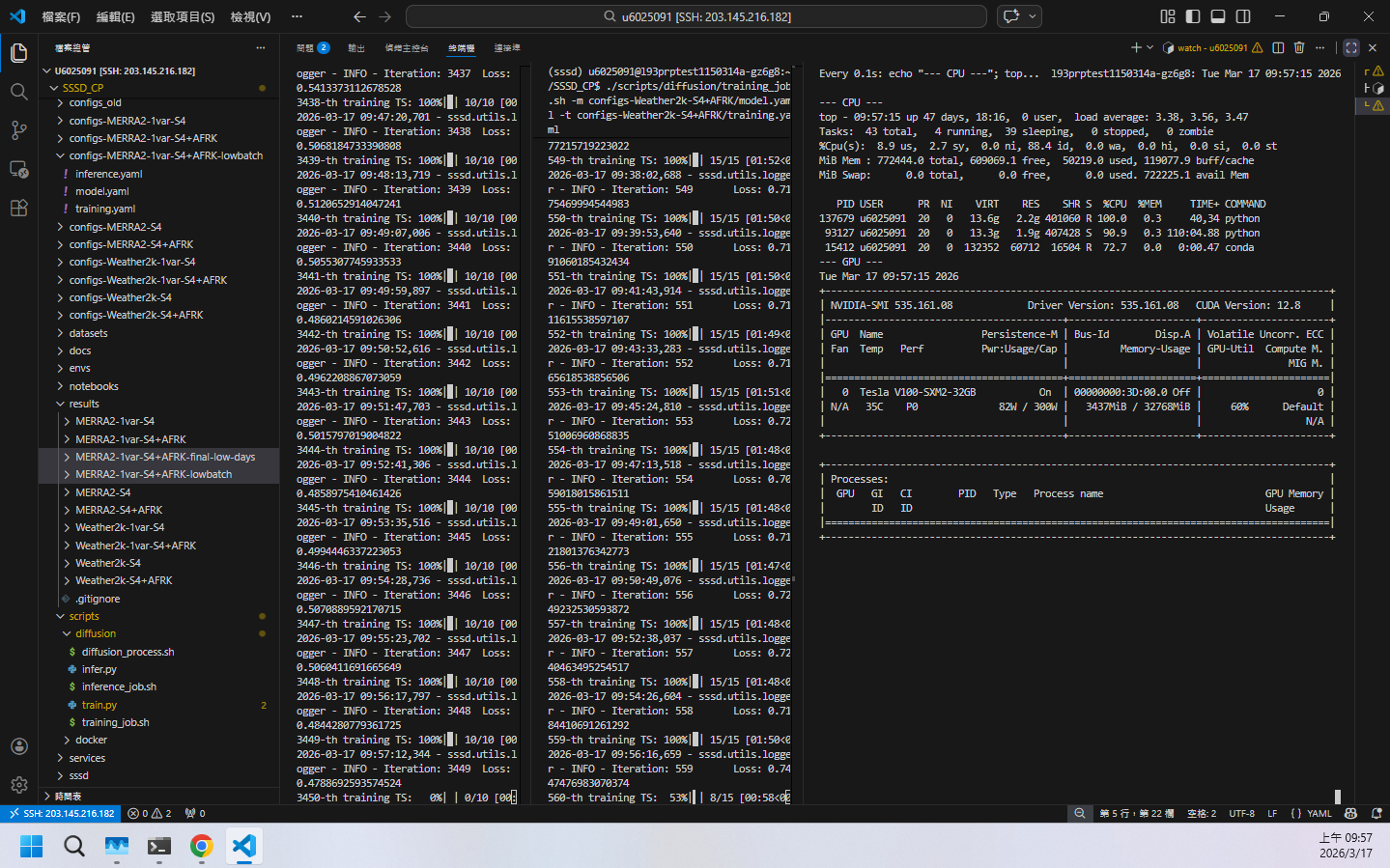
Experimental Snapshots
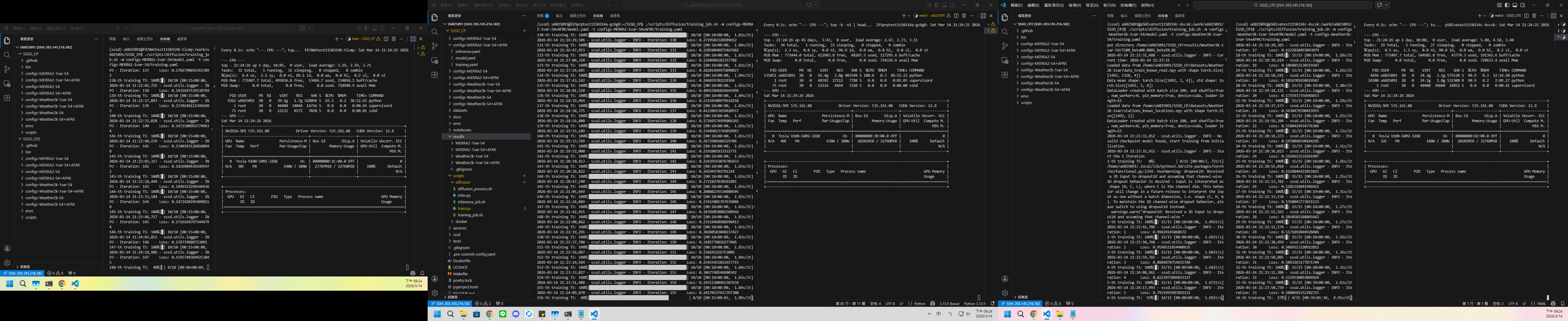
A total of four machines from the National Center for High-performance Computing (NCHC) were used in this experiment. Below are snapshots from three of these machines.
Draft Manuscript
References
- Zhu X, Xiong Y, Wu M, et al. Weather2K: A Multivariate Spatio-Temporal Benchmark Dataset for Meteorological Forecasting Based on Real-Time Observation Data from Ground Weather Stations[C]//International Conference on Artificial Intelligence and Statistics. PMLR, 2023: 2704-2722.
- Juan Lopez Alcaraz, Nils Strodthoff (2022). Diffusion-based time series imputation and forecasting with structured state space models. Transactions on Machine Learning Research. Retrieved from https://openreview.net/forum?id=hHiIbk7ApW
- SSSD (2022). GitHub. Retrieved from https://github.com/AI4HealthUOL/SSSD

Related Posts


![[Thought] Historical Earthquake Locations Around Taiwan](https://Josh-test-lab.github.io/posts/Historical%20Earthquake%20Locations%20Around%20Taiwan/cover%20image.webp)