Rectangular, Polar, and Spherical Coordinates
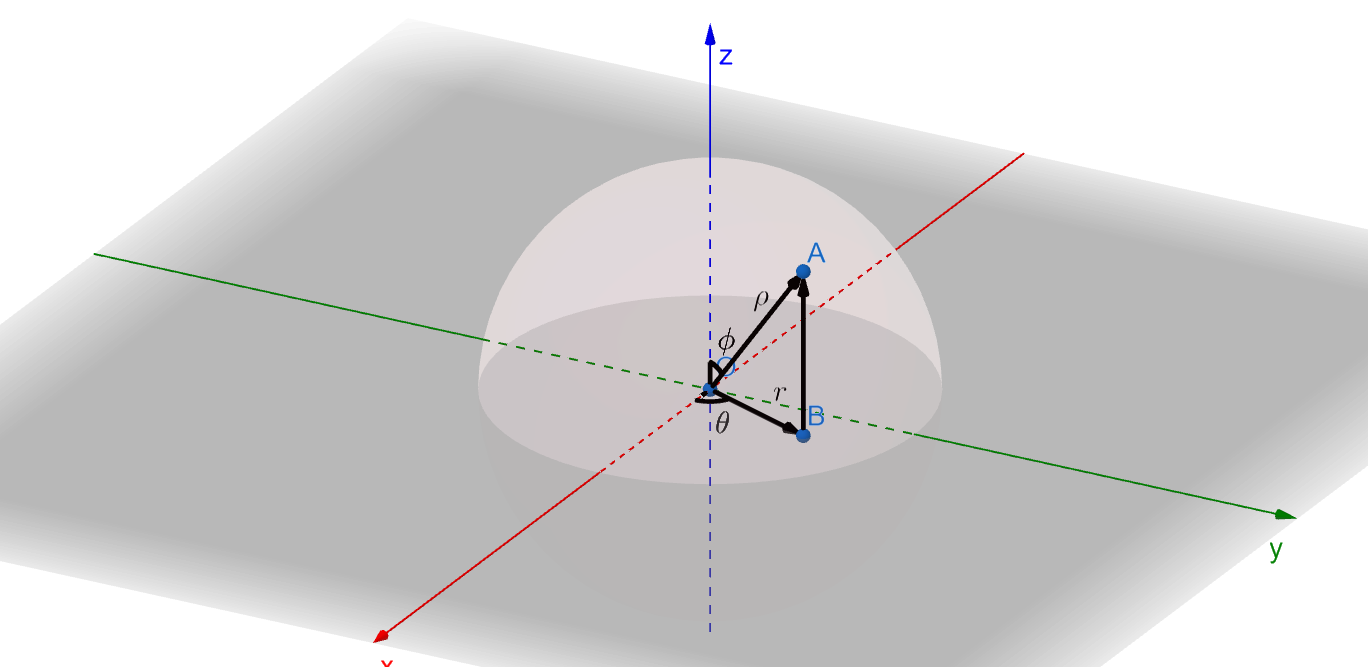
The cover image was created by the author using GeoGebra as an introduction to the spherical coordinate system, made on June 9, 2025.
Introduction
Common coordinate systems include the rectangular coordinate system, the polar coordinate system, and the spherical coordinate system. Each has its own applications, advantages, and limitations.
Rectangular Coordinate System
The rectangular coordinate system, also known as the Cartesian coordinate system, was introduced by the French mathematician René Descartes.

The rectangular coordinate system consists of axes that are mutually perpendicular and intersect at the origin. Every point in the coordinate system corresponds to a value on each axis.
2D Coordinate System
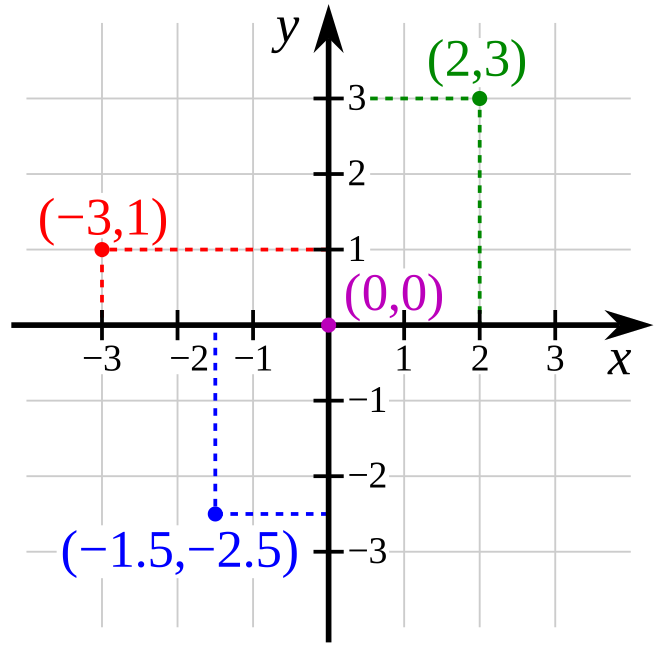
The 2D rectangular coordinate system usually consists of the $x$-axis and the $y$-axis, where the $x$-axis is the horizontal axis, and the $y$-axis is the vertical axis. The 2D coordinate plane is also called the $xy$-plane. When drawing a 2D rectangular coordinate system, the following rules apply:
- The $x$-axis and $y$-axis must be perpendicular to each other, intersecting at the origin, labeled as $\textit{O}$.
- The right side of the $x$-axis represents the positive direction, and the left side the negative.
- The upper side of the $y$-axis represents the positive direction, and the lower side the negative.
- Coordinate values are marked at fixed intervals along the axes.
- A point in 2D is represented as $(x, y)$.
3D Coordinate System
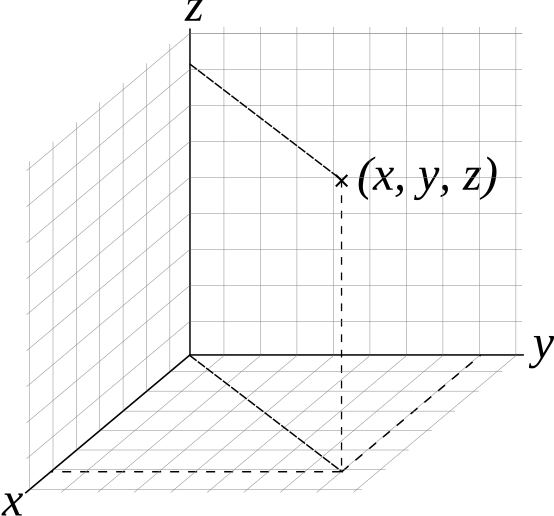
The 3D rectangular coordinate system is similar to the 2D version but includes an additional axis, the $z$-axis. The $x$, $y$, and $z$ axes are mutually orthogonal and intersect at the origin. Coordinates in 3D are labeled as $(x, y, z)$.
Polar Coordinate System
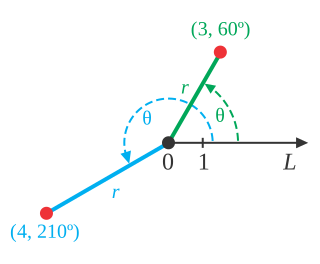
The polar coordinate system is a 2D system whose origin is unclear. Unlike the rectangular coordinate system, the polar coordinate of a point is determined by its distance $r$ from the origin and the angle $\theta$ from the reference axis $L$, which can also represent the angle between two points.
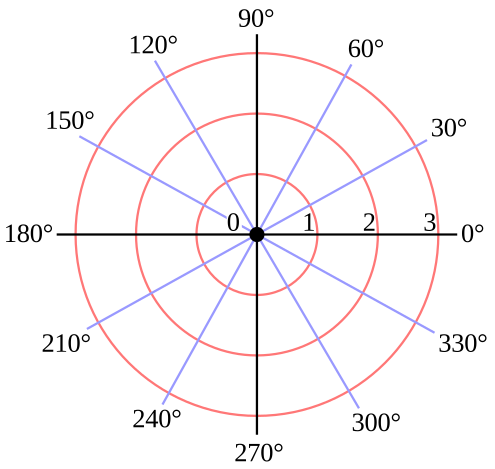
Points in polar coordinates are represented as $(r, \theta)$, where $\theta$ can be in radians. The conversion is:
$$ Degrees \times \frac{\pi}{180^\circ} = Radians $$
因此,可以有以下對應關係:
| Degrees | $0^\circ$ | $30^\circ$ | $60^\circ$ | $90^\circ$ | $120^\circ$ | $150^\circ$ | $180^\circ$ | $210^\circ$ | $240^\circ$ | $270^\circ$ | $300^\circ$ | $330^\circ$ |
|---|---|---|---|---|---|---|---|---|---|---|---|---|
| Radians | $0$、$2 \pi$ | $\frac{\pi}{6}$ | $\frac{\pi}{3}$ | $\frac{\pi}{2}$ | $\frac{2 \pi}{3}$ | $\frac{5 \pi}{6}$ | $\pi$ | $\frac{7 \pi}{6}$ | $\frac{4 \pi}{3}$ | $\frac{3 \pi}{2}$ | $\frac{5 \pi}{3}$ | $\frac{11 \pi}{6}$ |
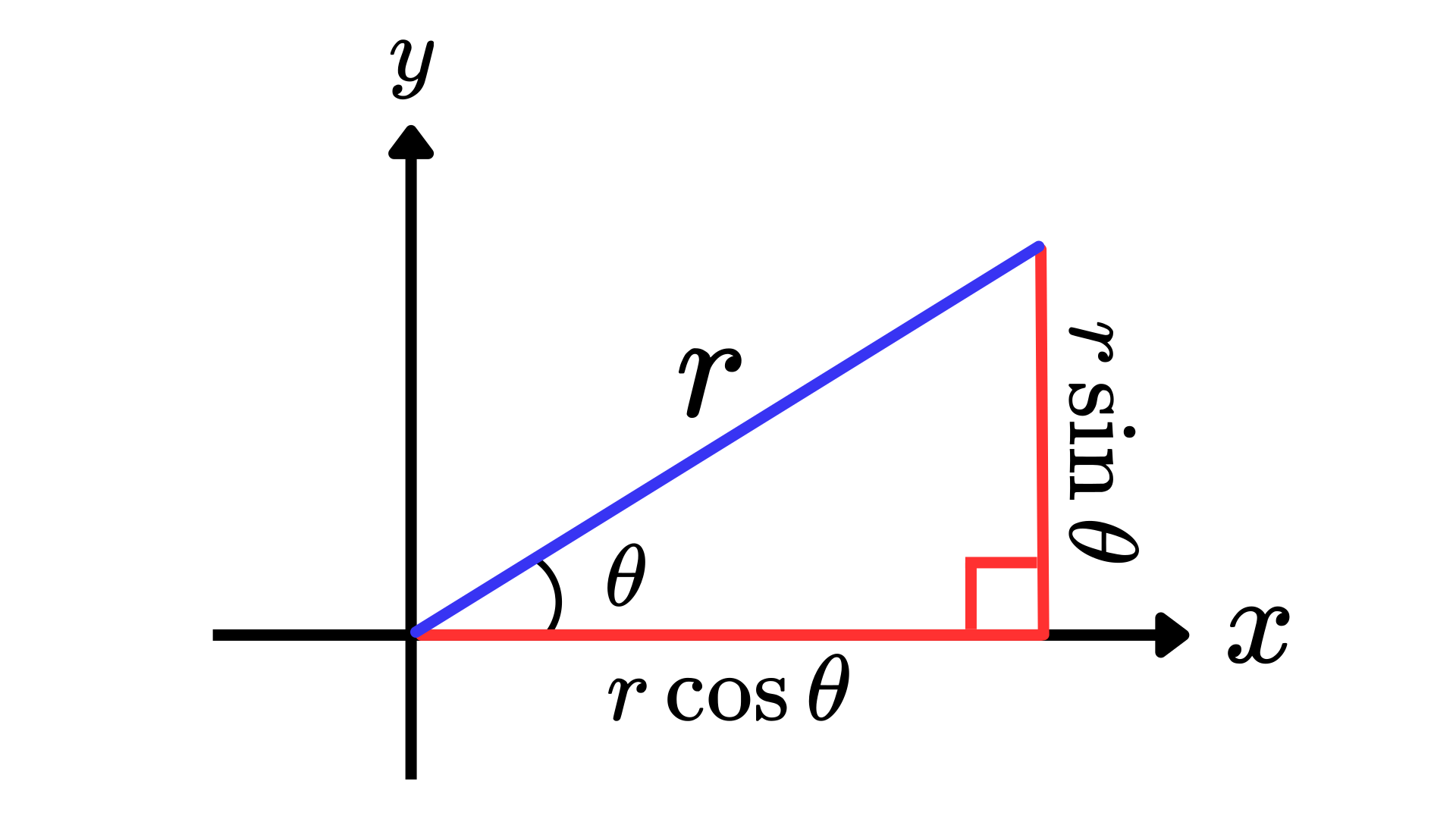
Since both polar and rectangular coordinates lie in a 2D plane, we can convert between them. From the image above:
$$ \begin{align*} & x = r \cos \theta; \\ & y = r \sin \theta. \end{align*} $$
Conversely, to convert from rectangular to polar coordinates:
$$ \begin{align*} & r = \sqrt{x^2 + y^2}; \\ & \theta = \begin{cases} \arctan(\frac{y}{x}) & \text{if } x > 0; \\ \arctan(\frac{y}{x}) + \pi & \text{if } x < 0 \text{ and } y \ge 0; \\ \arctan(\frac{y}{x}) - \pi & \text{if } x < 0 \text{ and } y < 0; \\ \frac{\pi}{2} & \text{if } x = 0 \text{ and } y > 0; \\ -\frac{\pi}{2} & \text{if } x = 0 \text{ and } y < 0; \\ 0 & \text{if } x = 0 \text{ and } y = 0. \end{cases} \end{align*} $$
Spherical Coordinate System
If you are unable to view the interactive spherical coordinate system model or need a full-screen view, please click here to access it.
The spherical coordinate system is an extension of the polar coordinate system by adding a third dimension, $z$-axis, making it suitable for describing points in 3D space.
Points in spherical coordinates are denoted as $(\rho, \theta, \phi)$, where:
- The $x$, $y$, and $z$ axes are mutually orthogonal and intersect at the origin, labeled as $\textit{O}$.
- $\rho$ is the distance from the origin to the point.
- $\theta$ is the angle from the positive $x$-axis to the projection on the $xy$-plane, $0 \leq \theta \leq 2\pi$.
- $\phi$ is the angle from the positive $z$-axis downward, $0 \leq \phi \leq \pi$.
The above definitions are widely accepted in mathematics. In physics, a slightly different convention is used, as shown below:
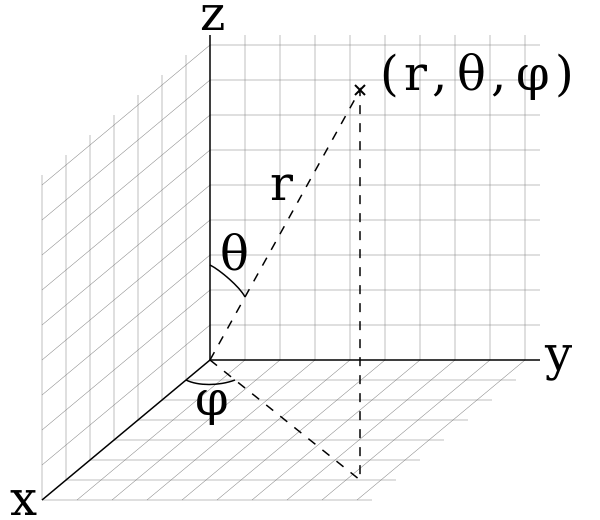
This article uses the mathematical definitions.
Like before, spherical coordinates can be converted to 3D Cartesian coordinates. From the interactive spherical model, we know that in the $xy$-plane:
$$ \begin{align*} & x = r \cos \theta; \\ & y = r \sin \theta; \end{align*} $$
This is the same as in polar coordinates. Next, since $\overrightarrow{AB}$ is parallel to the $z$-axis, by alternate interior angles, the angle between $\overrightarrow{OA}$ and the $z$-axis is $\angle OAB$. From triangle $\triangle OAB$:
$$ r = \rho \sin \phi, $$
So the conversion becomes:
$$ \begin{align*} & x = \rho \sin \phi \cos \theta; \\ & y = \rho \sin \phi \sin \theta; \\ & z = \rho \cos \phi. \end{align*} $$
To convert from Cartesian to spherical coordinates:
$$ \begin{align*} & \rho = \sqrt{x^2 + y^2 + z^2}; \\ & \theta = \arctan\left(\frac{y}{x}\right); \\ & \phi = \arctan\left(\frac{\sqrt{x^2 + y^2}}{z}\right). \end{align*} $$
References
René Descartes. (March 4, 2025). Wikipedia, the free encyclopedia. Retrieved on June 9, 2025, from https://zh.wikipedia.org/wiki/勒内·笛卡儿
Cartesian Coordinate System. (March 22, 2025). Wikipedia, the free encyclopedia. Retrieved on June 9, 2025, from https://zh.wikipedia.org/zh-tw/笛卡儿坐标系
Polar Coordinate System. (June 9, 2025). Wikipedia, the free encyclopedia. Retrieved on June 9, 2025, from https://zh.wikipedia.org/wiki/极坐标系
Radian. (March 15, 2025). Wikipedia, the free encyclopedia. Retrieved on June 9, 2025, from https://zh.wikipedia.org/wiki/弧度
Spherical Coordinate System. (February 8, 2025). Wikipedia, the free encyclopedia. Retrieved on June 9, 2025, from https://zh.wikipedia.org/zh-tw/球座標系
黑筆紅筆. (June 26, 2024). 球座標轉換的公式 [Video]. YouTube. Retrieved on June 9, 2025, from https://youtu.be/xxxqB-YnfX4

Related Posts